

YOUR DESIGN GUIDE | THE BEDROOM
THE BEDROOM, SOLVED
These are real questions people post every week:
“Help with awkward bedroom layout + off-center windows”
“How do I balance this awkward window placement?”
“Layout Advice – bed against windows or wall?”
They all sound like a question about the bed. They’re really a question about the wall. The bed is the biggest thing in a bedroom, and whatever wall it sits on becomes the wall everyone sees from the door. So the real question is: which wall deserves that job, and if it’s the one with the window, how do you make that look like a decision instead of a compromise?
A bed in front of a window can be one of the prettiest bedrooms you’ll ever sleep in. It just needs the right numbers. Here is how I work through it.
01 | Start with the sill, not the bed
Before anything moves, measure two things: the height of the window sill from the floor, and the height of your mattress top. That gap decides almost everything.
If the sill sits higher than your headboard will, you’re in great shape. The bed tucks under the window, the light falls across the bed, and the room feels open.
If the sill is low, you need a lower, softer headboard, or none at all, and you need curtains that work hard.

My numbers, on every bedroom like this:
No more than the bottom third. A headboard shouldn’t cover more than the bottom third of the window, and the bottom quarter is even better. That’s a rule of thumb from Emily Henderson’s team, and I agree with it.
Low means 14 to 24 inches. That’s the standard range for a low headboard, measured from the top of the mattress.
Leave 3 to 4 inches behind the headboard. My rule: just enough room for the curtains to close behind the bed.
24 inches to walk. My minimum on each side of the bed. 30 to 36 inches feels generous.
“The bed is a question about the wall. Whatever wall it sits on becomes the wall everyone sees from the door.”
02 | Window wall or solid wall?
Here’s my honest opinion: if the solid wall fits the bed with 24 inches on both sides and doesn’t block the door, I’d usually put the bed there. It’s easier to dress, easier to light, and you don’t wake up with the sun on your face.
But a lot of bedrooms don’t give you that choice. The solid wall has the closet, the door swings into it, or the room is just too narrow. That’s when the window wall wins, and it can be beautiful.

One thing that isn’t a style choice: in most homes, a bedroom window doubles as the emergency way out. Under the International Residential Code, an escape window can’t have a sill more than 44 inches above the floor, and it needs at least 5.7 square feet of clear opening. So whatever you put in front of it, you need to be able to reach it and open it. A low upholstered headboard is fine. A tall solid one jammed against the glass is not. Codes vary by city, so check your local requirements with your contractor.
03 | When the window is off-center
This is the one that makes people crazy. The window is pushed to one side, so a centered bed looks lopsided and a bed centered on the window crowds the door.
My rule: center the bed on the wall, not the window. The wall is what you see. An off-center window behind a centered bed reads as a choice once you balance it.
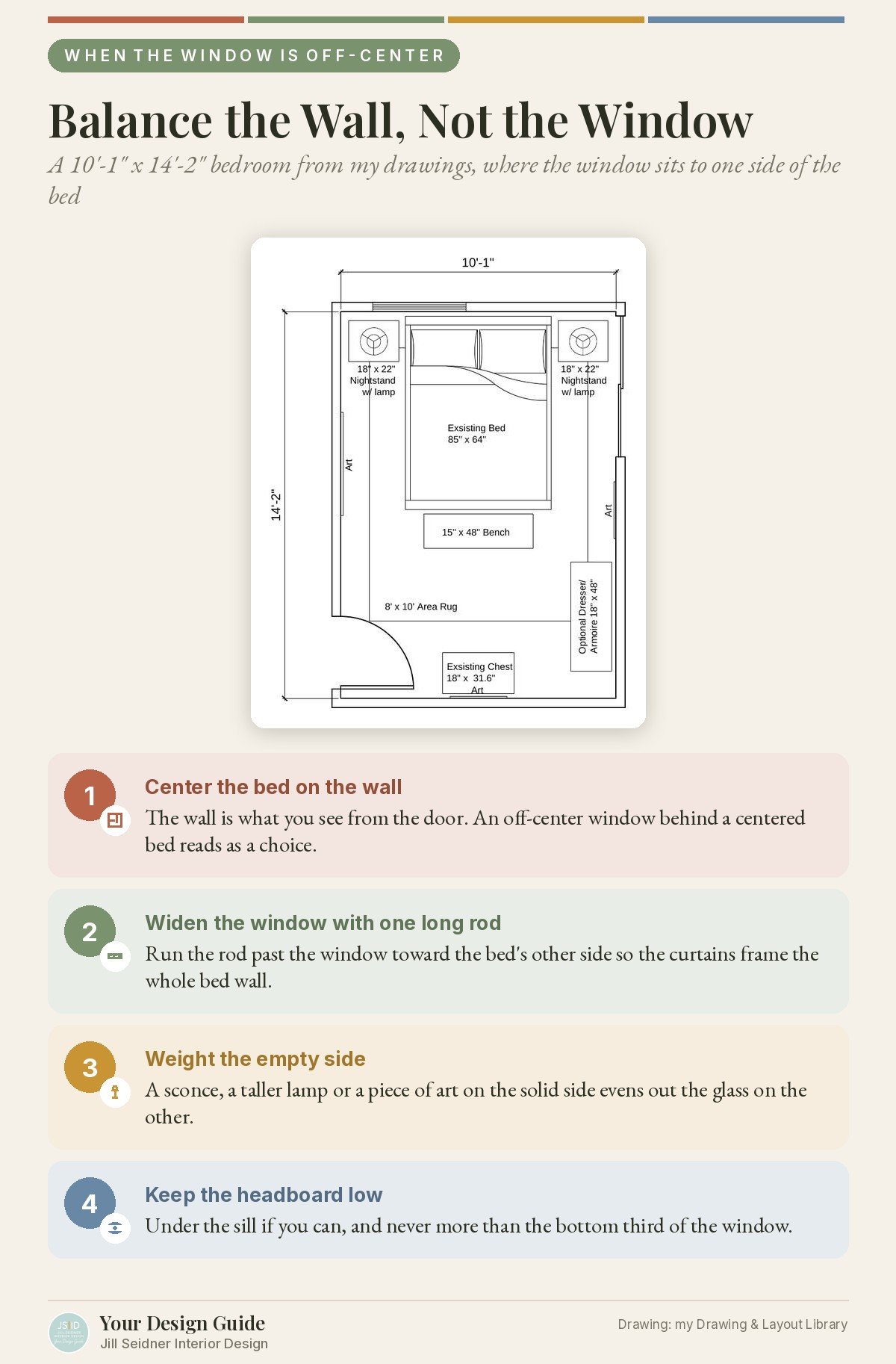
How I balance it:
One long rod. Run the curtain rod past the window toward the other side of the bed, so the curtains frame the whole bed wall instead of just the glass. Extend it 8 to 12 inches past the frame on the window side so the panels stack off the glass. (My rule.)
Weight the empty side. Put the visual weight where the glass isn’t: a plug-in sconce, a slightly taller lamp, or a piece of art on the solid side.
Match the heights, not the pieces. Nightstands can be different, as long as their tops land at about the same height, close to the top of your mattress.
Keep the headboard low. Under the sill if you can.
04 | Make it look intentional
Once the bed is placed, a few details turn “we had no choice” into “we planned this”:
Curtains that go to the floor. Short curtains that stop at the sill make the window look smaller and the bed look stuck. Floor-length panels, hung high and wide, make the whole wall feel taller.
Lined or blackout panels. If the sun comes up right behind your head, a lined linen panel makes the bed usable on Saturday morning.
Reading light off the window. A plug-in sconce on each side, or one on the solid side, keeps the nightstand clear and doesn’t fight the glass.
One calm color across the bed. When the window is busy with light and view, a quiet duvet keeps the wall from feeling cluttered.
DESIGNER NOTE
If you only do one thing this week: measure your sill height and your mattress height tonight. Those two numbers tell you which headboard to buy, or whether you even need one.
05 | Shop the bed wall

I may earn a commission from links on this page.
Gabriella Blackout Linen Curtain Panel (Joss & Main). Lined linen that closes fully behind the bed.
Ellen Plug-In Sconce (McGee & Co.). A reading light with no hardwiring, so the window stays clear.
Williams Mahogany Nightstand (AllModern). Sits low, under the sill line.
Momsen Drum Ceramic Table Lamp (Birch Lane). A little height on the solid side of the wall.
Linen Duvet Cover (Parachute Home). One calm color across the bed.
Faux Linen Storage Bench (Birch Lane). Finishes the foot of the bed and holds the extra blanket.
Plan it on paper first
The easiest way to settle where the bed goes is to draw the room before you move anything. My Drawing & Layout Library has the floor plans, elevations and lighting plans I use, including bedrooms like the two in this post, plus a guide to reading and drawing your own.
Want help with your own room?
Stuck on a bedroom that just won’t work? That’s exactly what I do for clients. Book an online design consultation and we’ll figure out where the bed goes, what to do with the window, and what to buy, using your photos and measurements.
More from Your Design Guide:
- Hotel Moves for Home: 7 Details That Make Your Bedroom Feel Like Checking In
- Your Week of Rooms, Planned: 7 Easy Room Formulas
Tell me in the comments: is your bed on the window wall or the solid wall?
Bed in front of a window: FAQ
Is it OK to put a bed in front of a window?
Yes, it can be one of the prettiest bedrooms you’ll sleep in. If the solid wall fits the bed with 24 inches on both sides and doesn’t block the door, I’d usually put it there; when it doesn’t, the window wall wins with the right numbers.
How tall should a headboard be in front of a window?
It shouldn’t cover more than the bottom third of the window, and the bottom quarter is even better. A low headboard is 14 to 24 inches above the top of the mattress, and leave 3 to 4 inches behind it so the curtains can close.
Where do I center the bed if the window is off-center?
Center the bed on the wall, not the window. Then balance it with one long curtain rod across the bed wall and visual weight, like a plug-in sconce or art, on the solid side.
Can a bed block a bedroom window?
Keep it reachable. In most homes the bedroom window is the emergency way out, so a low upholstered headboard is fine, but a tall solid one jammed against the glass is not. Codes vary by city, so check your local requirements with your contractor.
Sources: Emily Henderson, “Our Expert Rules for Putting a Bed in Front of a Window” · IRC R310 Emergency Escape and Rescue Openings (summary, weknowcodes.com)
Your Room-by-Room Design Playbook
Every room has a formula. Paid members get the whole one, step by step.
Paid members get:
Full step-by-step room guides with printable checklists
Room formulas and shopping lists you can copy
Ask a Designer Wednesday: post your room and I answer
Read more on Substack: subscribe free for more room fixes like this, or upgrade for all the perks.
Originally published on Your Design Guide. Read the full post and the comments on Substack: Bed in Front of a Window: When It Works, and How I Make It Look Intentional

